
40+ employee testimonial questions for HR and recruiting teams
Prompt questions by scenario — first 90 days, long tenure, internal moves, remote work, ERG stories, and alumni — with what to listen for in each answer. Copy, adapt, paste into your recording page.
Instantly collect video proof from your clients.
Your branding, their voice.
+24% Conversion Rate
Boost trust and sales instantly.
No-Code Integration
Copy-paste the widget in seconds.
Zero Friction
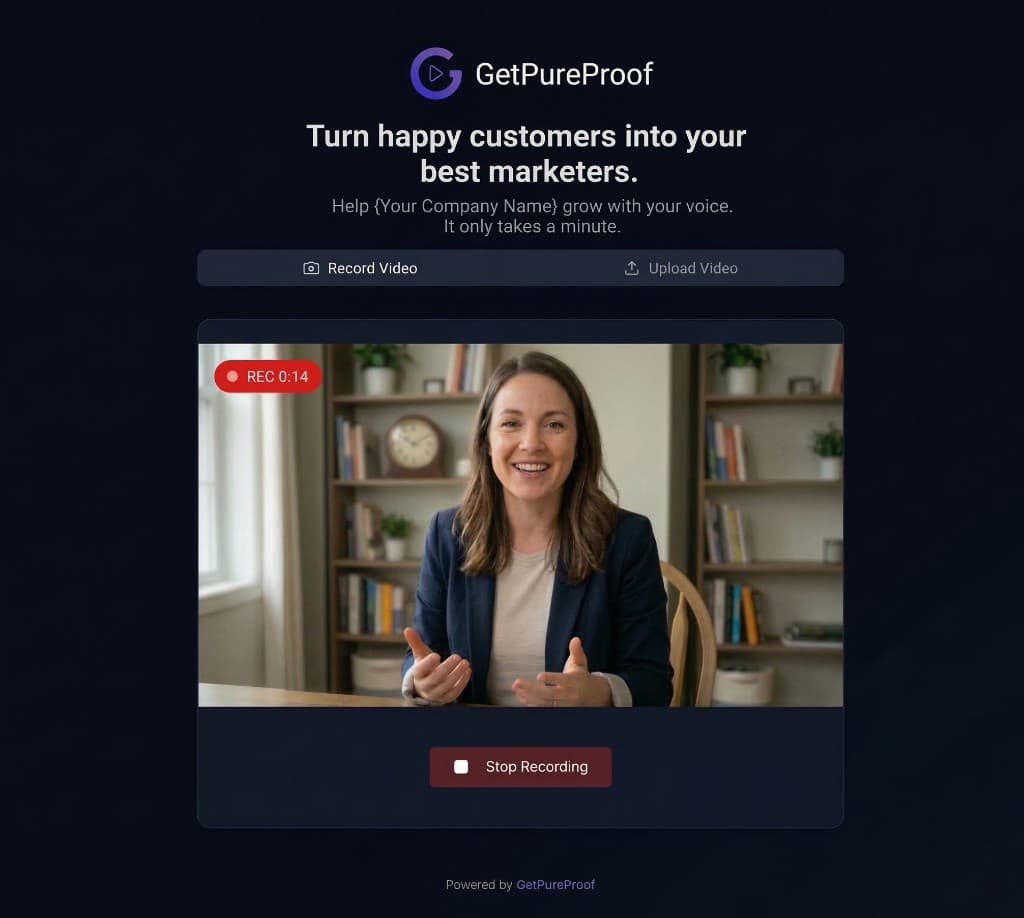
Customers record in-browser. No app needed.
What questions should you ask in an employee testimonial video?
Ask questions that force a specific memory rather than a general opinion. "What do you like about working here?" produces a sentence nobody believes; "what surprised you in your first month?" produces a story a candidate can picture. Three to five prompts per recording is the working range — enough structure that nobody freezes on camera, few enough that the employee stays in their own words.
One rule before the lists: these are prompts, not a script. If the employee reads their answer, the clip stops working. Send the questions ahead so they can think, then let them talk.
Employee testimonial questions for new hires (first 90 days)
The most useful clips for candidates at application stage, because recent hires still remember the candidate experience.
- What were you doing before you joined, and what made you apply here?
- Walk me through your first week. What actually happened?
- What surprised you in your first month — good or bad?
- Was there anything about the job that turned out different from the interviews?
- Who helped you most when you were getting started, and how?
- What did you get access to on day one that you expected to wait weeks for?
- What was the first thing you shipped, wrote, closed, or fixed?
- If a friend were interviewing here next week, what would you tell them to expect?
What to listen for: a concrete week-one detail, one honest friction point, and the name of a person or team who helped. A clip with all three reads as real to a candidate; a clip with none reads as a company statement.
Employee testimonial questions for long-tenured employees
These answer the question candidates cannot ask in an interview: does this place still make sense after the novelty wears off?
- How long have you been here, and how has your role changed since you started?
- What is different about the company now compared to when you joined?
- What kept you here through a period when you could have left?
- What is something you can do now that you could not do when you arrived?
- What is the hardest thing you have worked on here?
- Who has had the biggest influence on how you work?
- What would have to change for you to still be here in three years?
What to listen for: evidence of growth with specifics (a skill, a scope change, a project), and a candid answer to what nearly made them leave. Unqualified loyalty sounds coached.
Employee testimonial questions about internal mobility and promotion
Proof that a career path exists, told by someone who walked it.
- What role did you start in, and what role are you in now?
- How did the move come about — did you ask, or were you approached?
- What did the process actually look like, and how long did it take?
- What did you have to learn to be credible in the new role?
- Who advocated for you, and what did that support look like in practice?
- What would you tell someone here who wants to make a similar move?
What to listen for: mechanics, not sentiment — who decided, how long, what was required. Specifics here are the difference between a career-path claim and a career-path proof.
Employee testimonial questions about remote and distributed work
Candidates evaluating a remote role want to know whether remote is genuinely supported or merely tolerated.
- Where do you work from, and what does a normal week look like?
- How many hours of your week are meetings, honestly?
- How do timezones affect your work, and what does the team do about it?
- When was the last time you were in the same room as your team, and why?
- What is harder about this job remotely than it would be in an office?
- What tool or habit makes remote work function on your team?
What to listen for: a real number (meeting hours, timezone spread) and an admitted downside. A remote clip with no downside is not credible.
Employee testimonial questions for ERG, DEI, and identity-based stories
Consent and editorial control matter most here. The employee should see and approve the clip before it goes live, and should be able to withdraw it later without a negotiation.
- What drew you to this company, and what made you decide to stay?
- Have you found people here who understand your experience? How did you find them?
- What has the company done that actually helped, as opposed to announced?
- What is still not working, and what would you change?
- What would you want a candidate from a similar background to know before they apply?
- What role have ERGs or employee networks played for you, if any?
What to listen for: the answer to question four. A story that includes something unresolved is far more persuasive to a skeptical candidate than one that does not — and it signals a company confident enough to publish it.
Employee testimonial questions for alumni
Former employees who left on good terms demonstrate something no current employee can claim credibly: the company develops people who move on well.
- How long were you there, and what were you doing when you left?
- What did you learn there that you still use?
- What made you decide to move on?
- What would you tell someone considering the job you had?
- Looking back, what did the company get right?
What to listen for: a skill or habit they carried forward, and a departure explained without bitterness. Ask alumni questions in a separate space with its own consent language, since a former employee's permissions differ from a current employee's.
Employee testimonial questions to avoid
- "Would you recommend working here?" — a yes/no with an obvious right answer in front of an employer.
- "What are our values to you?" — invites the employee to recite the values page.
- "What is your favorite perk?" — perks are the least differentiating and most copyable thing about any employer.
- Anything requiring a compliment. If the question can only be answered positively, the answer carries no information.
- Anything evaluative about a named colleague or manager. That is a performance conversation, not a testimonial, and it does not belong in publishable content. The boundary and its legal reasoning: employee testimonial consent and GDPR.
How to run the recording
Put three to five questions on the recording page itself so the employee sees the prompts while they record, and keep each clip to a single scenario. Recording should happen in a browser on whatever device the employee already has — no app to install, no account to create — because every step before recording starts costs you completions. Then moderate: submissions land in a queue, HR approves what publishes, and nothing goes live by accident.
Asking well matters as much as the questions themselves, given the power asymmetry between employer and employee — see how to ask employees for video testimonials. For tooling, the buying criteria are in the guide to video testimonial software, and the HR-specific setup lives on video testimonials for HR and recruiting.
Frequently asked questions
Running employee testimonial interviews.
Pick five questions. Send one link. Get your first clip today.
Set up a branded recording space in under two minutes, on the permanent free plan.
Start for free